
Where are the textbooks? The use of main lesson books in Waldorf education
First published in 2019. Updated in 2026 to reflect current research on how students learn.
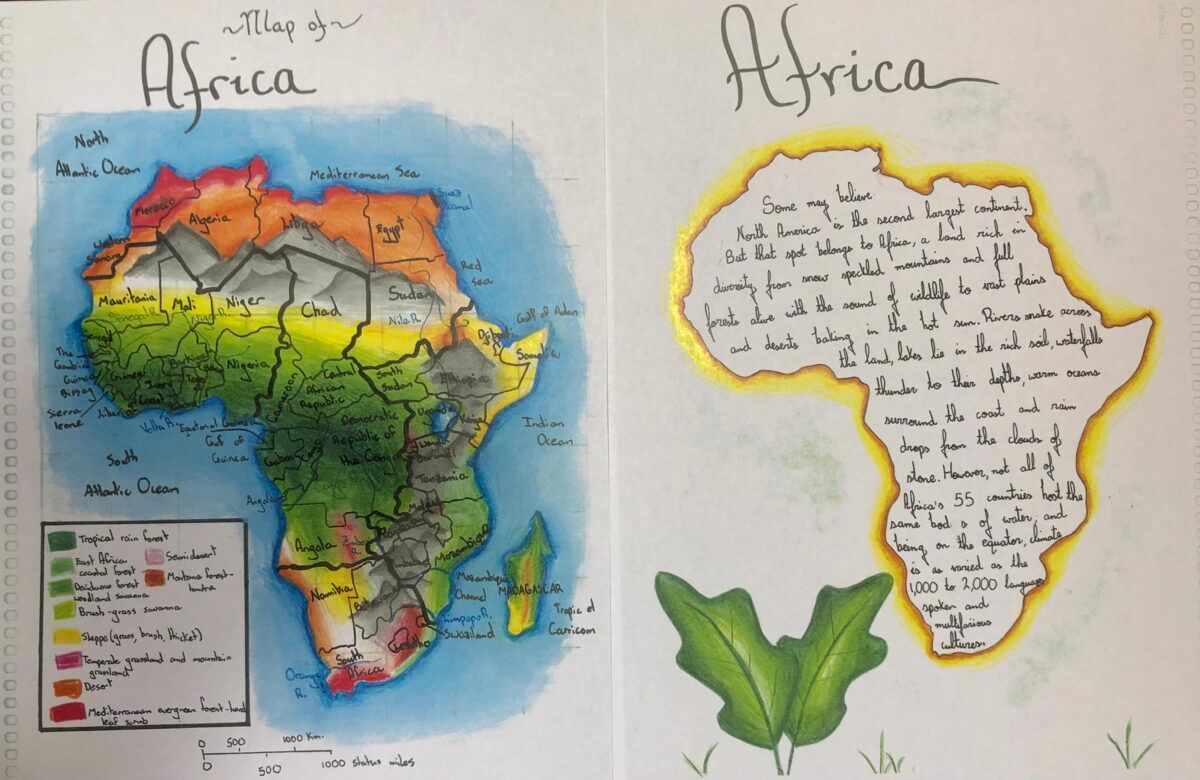
Main lesson books are unique to Waldorf education. While traditional schooling pairs lecturing with textbook references and worksheets, Waldorf students process and record lectures in notes and illustrations on large, blank pages of high-quality paper.
What are these books exactly, and why do Waldorf schools use them?
What is a main lesson book?
The creation of a main lesson book is an active, hands-on experience of learning that encourages both intention and creativity. Waldorf students record the content of each subject of study, presented during a student’s main lesson class, in a main lesson book.
These creative, curriculum-rich books become the culmination of all students have learned, in depth, for the year about a topic. These topics, such as history, science and mathematics to name a few, are taught in four-week blocks, and the books serve as both learning tools and documentation of the work learned.
Every main lesson features daily work in the main lesson book. The student writes and illustrates the lesson’s content into their books. This content consists of relevant illustrations, stories, notes and summaries, all written by hand. Children are given freedom within the creation of their books about both what they write and how they illustrate. This makes both the book and the content of the lesson their own.
What is its purpose?
The main lesson book serves many important purposes. On a practical level, it replaces the textbooks and worksheets seen in other schools. Instead of referencing a book as support material to what a teacher teaches, the teacher is the source material, and the main lesson book becomes the creative, holistic recording of that imparted knowledge.
In this way, students learn through listening and re-interpreting the teacher’s lessons into usable notes and pieces of information, both recording and processing the information as they go along. This is done alongside creative and artistic representations of the material. This brings personalization, beauty, joy and relevancy to lessons.
The goal is better absorption of the material on a deeper level, as well as inspiring a joy in learning. Children in Waldorf schools are learning to learn and learning to love learning. Memorization for tests, or temporary learning to simply prove out rote work, is never the goal.
A textbook tells a student what they are going to learn. A main lesson book records what they did learn. That difference is the whole idea.
Does a main lesson book help with learning?
There is good reason to think so, though it is worth being careful about what the research actually shows. No study has examined Waldorf main lesson books directly. What has been studied are the separate habits a main lesson book is built from.
The best established of these is what psychologists call the generation effect: people remember material they produce themselves better than material they simply read. It was first described by Norman Slamecka and Peter Graf in 1978, and it has since been confirmed by two separate meta-analyses drawing together decades of studies. A student who listens to a lesson and then has to render it in their own words and images is generating, not receiving. That is the mechanism the main lesson book relies on most.
Drawing appears to help too. Research by Jeffrey Wammes and colleagues at Waterloo found that drawing a word produced better recall than writing it out, across seven experiments. The effect is real, though not universal: a 2025 study asking students to illustrate scientific definitions found no advantage over writing, so it seems to depend on what is being drawn and how.
Handwriting itself is the least settled of the three. A widely cited 2014 study suggested students who took notes by hand understood more than those typing, because typists tend to transcribe while writers must summarize. Larger replications since have not found the memory advantage, and what holds up is the narrower finding: writing by hand forces you to condense and rephrase, while typing lets you copy without thinking. For a main lesson book, that is the part that matters anyway.
So the honest version is this. Making a main lesson book asks a child to generate, retrieve and illustrate what they have learned rather than receive it. Each of those has independent support. The book itself has not been put under a microscope, and we would rather say that plainly than claim more than we can.
What a main lesson book does not do
It is worth naming the trade-off.
A textbook is a reference. It sits on a shelf and opens to the right page four years later. A main lesson book is the record of an experience, and it is not organized for looking things up. A student who joins us partway through a year does not arrive with a volume to read their way in, and a student who misses a block cannot simply borrow the text.
We handle that with teaching rather than with books, and in practice students settle. It is still a real difference, and a family weighing the move is better off hearing it from us now than discovering it in October.
Will my child be behind?
For most families this is the question underneath the first one, so here is what we do.
Students receive standard grades, along with a narrative assessment and a self-evaluation at the end of each class, and transcripts are available on request. Homework starts in Grades 3 and 4 and builds to 30 minutes to an hour a night by Grade 8. As a private, accredited school, we are not required by state law to use standardized testing, and we do not offer AP courses; Grade 11 and 12 coursework is considered on par with honors, and high school students can take courses at Santa Rosa Junior College through our cross-study program. Our Frequently Asked Questions page sets each of these out in more detail.
High school math and science classes do refer to textbooks, but the textbooks don’t dictate the courses.
Over the past five years, more than 97% of our graduates have gone to college directly out of high school, and 83% have attended four-year colleges.
Are they worth it?
Are main lesson books fun for children to create? Yes. Are they treasured keepsakes for years to come? Absolutely. But they are also serious tools for the deep processing of information, and a creative culmination of all that is being learned in the student’s day and year.
They are easiest to understand by holding one. They are out on the desks during any tour, and students are usually glad to show you theirs.